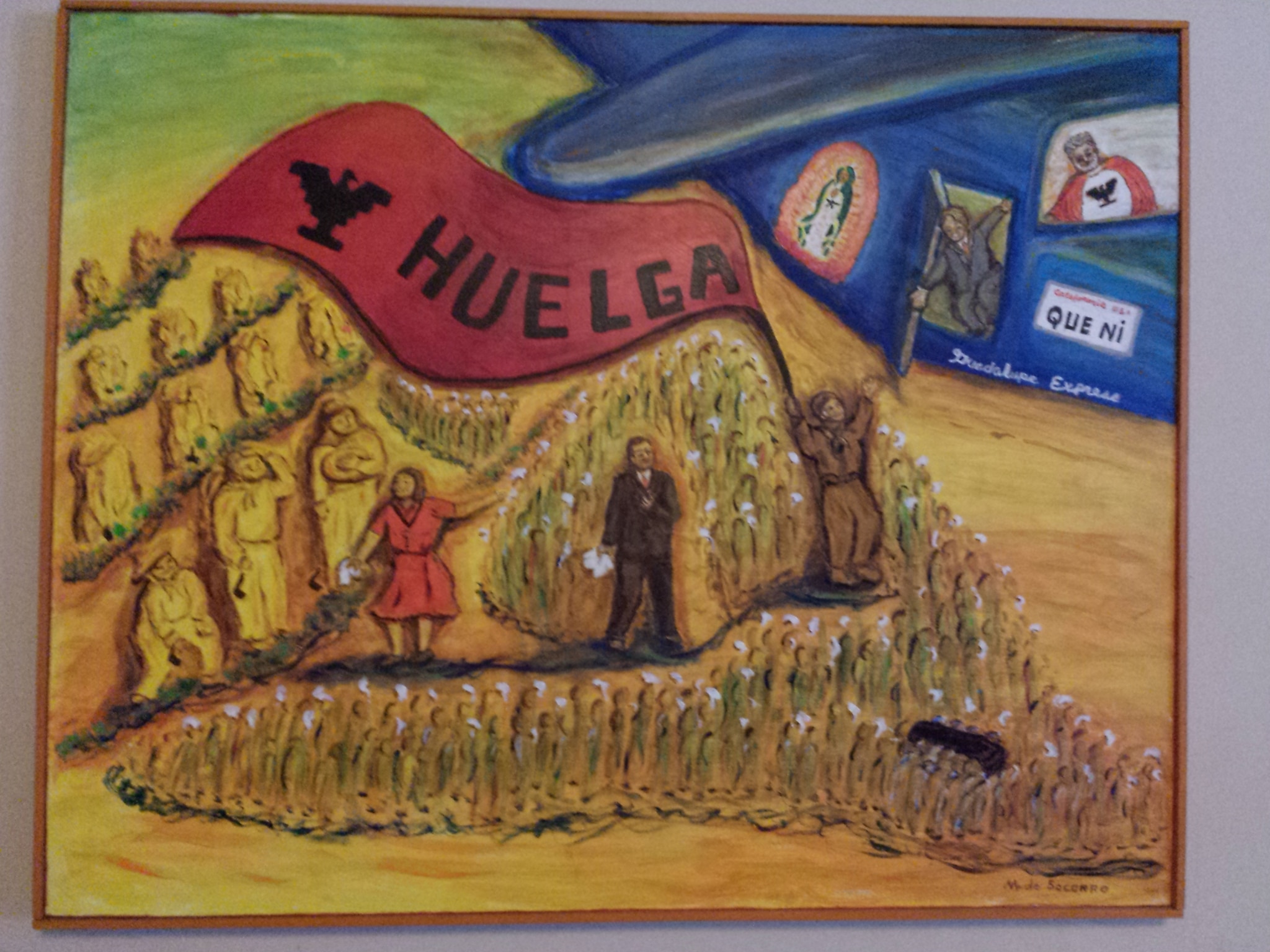
The new film Cesar Chavez opened this weekend, helping raise awareness about the labor leader’s pivotal role in American labor and civil rights history. Sacramento has an opportunity to portray its important role in one of the pivotal events of the 20th Century, portrayed in the film, by commemorating the 1966 march from Delano to Sacramento via a site on Capitol Mall.
Last summer, I was asked by a Downtown Sacramento Partnership representative to suggest a few “supergraphic” images to be placed on the big panels around the vacant lot at 3rd and Capitol. The old posters were starting to get a bit the worse for wear, and DSP wanted to replace them with individuals from Sacramento history who would embody the “Dreamers Welcome” brand they are utilizing to market downtown Sacramento. I had a few suggestions, including Betty Inada, a Sacramento-born singer who went on to great fame as a jazz singer in Japan in the 1930s, but got her start in the Japantown neighborhood where Capitol Mall now sits,. Other suggestions included a local musician or club owner from the same neighborhood, like Hovey Moore of the Mo-Mo Club, “Nitz” Jackson of the Zanzibar, or mortician/musician “Ted” Thompson. I even suggested a few color slides I have of Japantown prior to redevelopment, to give “then and now” perspective. But the best “dreamer” I could think of with a direct relevance to the history of Capitol Mall was Cesar Chavez and the 1966 march from Delano to Sacramento. The Center for Sacramento History has large-format photographs of the march from the Sacramento Bee “photo morgue” that could be blown up to large size to be superimposed on the fence at 3rd and Capitol, right where this historic march took place.
In many ways, the 1966 march was the West Coast’s equivalent to Dr. Martin Luther King Jr.’s march on Washington, celebrated widely on its 50th anniversary last year. It drew enormous media attention, and as the strike was resolved just as the marchers approached Sacramento, its final approach became a victory celebration. Of course, the march from Delano to Sacramento did not end at Capitol Mall. The march also had a religious purpose as a pilgrimage, arriving on Easter Sunday, and pilgrimages end at a religious site, not a seat of government. When the speeches and press conferences at the Capitol were completed, the marchers continued to Our Lady of Guadalupe Church at 8th and T Street in Southside Park, where they were welcomed by the local community. The march represented a pivotal moment in the history of California agriculture, and was one of the major events that inspired the “Chicano Movement” and generations of leaders, including future Sacramento mayor Joe Serna, and artists, like the Sacramento-based Royal Chicano Air Force, both of whom became very active with Chavez’s work in subsequent years. The march was thoroughly documented by national media, so there is no shortage of imagery or documentation for the event. I didn’t hear back from Downtown Sacramento Partnership regarding my suggestions, but they decided to use some other images of art from the Crocker collection on the walls surrounding 3rd and Capitol. Considering the recent changes occurring near the site, including development of a downtown arena, we are seeing stirrings of interest in building something else on that lot that may make those DSP supergraphics redundant. The site, originally intended for the 301 Capitol Mall Towers project, may be part of a new residential development now that the economic collapse that brought the Towers project down may be past. Could a new building on 3rd and Capitol include some sort of public art or commemoration of the march from Delano to Sacramento?
Sacramento already has a park named after Chavez, at 10th and Capitol, just as we have other parks named for historic figures, related to Sacramento or not, from McClatchy to McKinley, Belle Cooledge and John Cabrillo. But a site on Capitol Mall also commemorates the role played by the thousands of marchers who accompanied Chavez, and the labor leaders who worked alongside him, like Dolores Huerta, or Filipino labor leader Larry Itilong. The block from 3rd and 4th, Capitol to L Street was part of Sacramento’s Japantown, but many of the businesses and residents on the block were representative of Sacramento’s Filipino and Mexican community, including Filipino social clubs and the “Bataan News” newspaper, Mexican restaurants and markets. By the time of the 1966 march, most of this neighborhood was swept away by redevelopment, and what little remained was awaiting demolition for the path of Interstate 5. If a new building is planned for the site, could architectural or muralism elements be used to recognize the stories of those who came before, or came to Sacramento during these earlier areas and this pivotal event? Many recent public events celebrating local agriculture and food processing industries, and its products, have taken place on Capitol Mall, like Sacramento’s “Beer Week” and last year’s “Farm to Fork” Festival, including a dinner on the Tower Bridge itself. But most of these events pay little attention to the role of the laborers whose work is what brings the bounty of California’s farms to the forks of big cities like Sacramento.
The 50th anniversary of the Delano to Sacramento march is two years away, in April of 2016. What could Sacramento do to commemorate and celebrate this historic event? Could new plans for the former Capitol Towers site, or city sites transferred to the arena owners at the southwest corner of 3rd and Capitol, integrate public art, murals or other features that would tell the story of a world-changing event that took place on Sacramento’s doorstep? Could the eyes of the nation be on Sacramento in 2016, celebrating the 50th anniversary of a civil rights march that changed American history, and could we use it to bring positive attention to downtown Sacramento and our contemporary role in California, just as new construction is underway in the city’s heart?
(Note: The artwork at the top of this story was painted by Mareia de Socorro, a resident of Sacramento for over 80 years. The painting, entitled “Guadalupe Express,” depicts the funeral of Cesar Chavez in 1993. Chavez is holding a “Hulega” (Strike) flag, and boarding an airplane piloted by Keith Kenny, parish priest of Sacramento’s Our Lady of Guadalupe Church (Father Kenny was a pilot) and being welcomed aboard by Robert Kennedy, who visited the 1966 strike during the march. Behind him are Sacramento mayor Joe Serna and fellow labor leader Dolores Huerta.)